
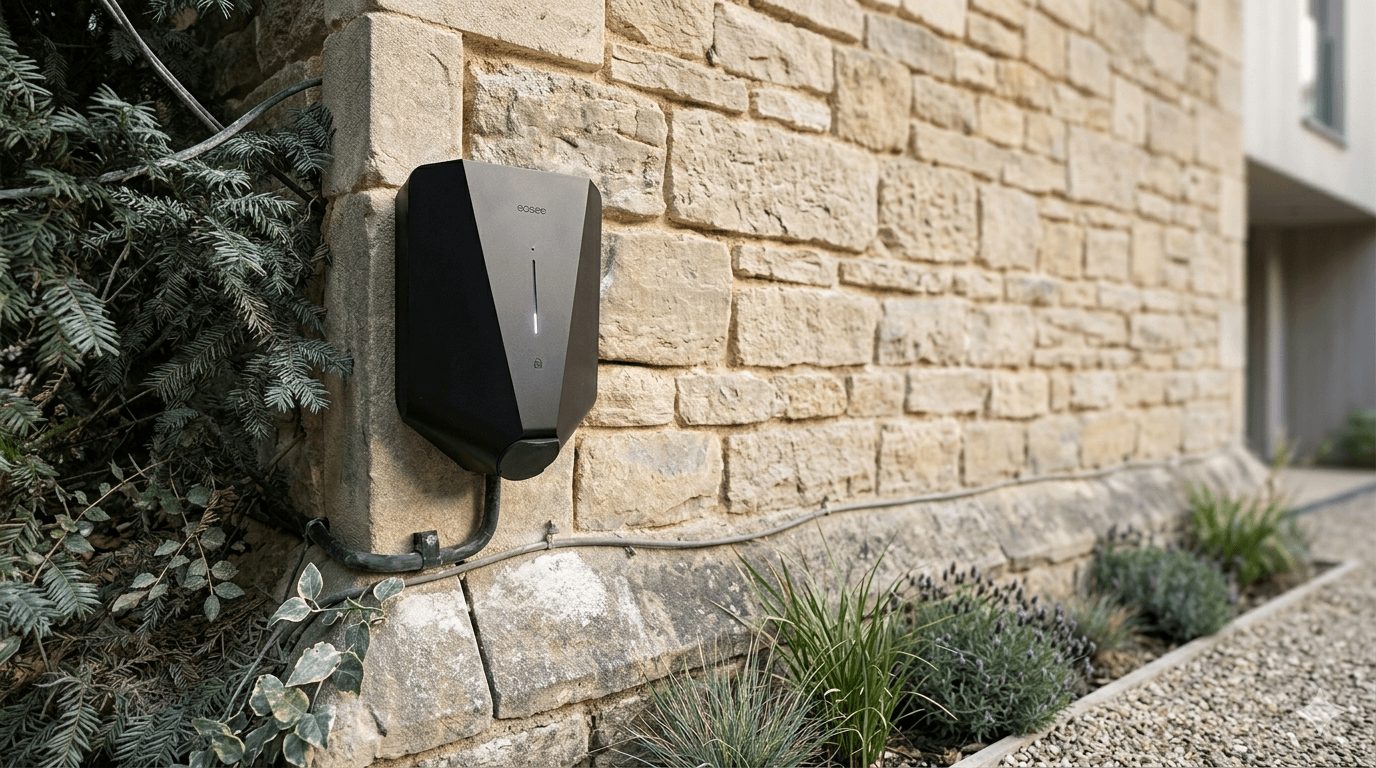
The Easee One is one of the most popular home EV chargers in Europe — and for good reason. Its slim, minimalist design, robust smart features, and excellent load balancing capabilities have made it a firm favourite with UK homeowners. But is it the right charger for you? As NAPIT-registered EV charger installers serving Watford and Hertfordshire, we’ve installed plenty of Easee units and can give you a straight answer.
What Is the Easee EV Charger?
Easee is a Norwegian company that launched in 2018 with a simple goal: to make EV charging smarter, more compact, and more future-proof. The Easee One is their flagship home charger — a 7.4kW single-phase unit that stands out for its dynamic load balancing technology and the ability to connect multiple chargers together for multi-EV households.
The Easee Charge is the commercial counterpart, but for most Hertfordshire homeowners, the Easee One is the product to consider. Its compact dimensions (smaller than most competing chargers) make it particularly well-suited to tight garage walls or narrow driveway positions.
Easee One Key Features
- Dynamic Load Balancing: Monitors overall household electricity consumption in real time and automatically adjusts charging power to stay within your main fuse limit. Essential for older properties or limited electrical supply.
- Multi-charger Equalisation: Connect multiple Easee chargers together and the system automatically distributes available power between them — ideal for households with two EVs.
- Easee App: Intuitive control for scheduling, monitoring, and managing your charging sessions. Track costs, set limits, and view charging history.
- Smart Tariff Integration: Schedule charging during off-peak hours to reduce running costs. Compatible with major UK smart tariffs.
- Compact Design: One of the smallest 7.4kW chargers available — discreet installation on walls where space is limited.
- Modular Construction: Internal components are replaceable, which makes the unit more repairable and future-proof than sealed competitors.
- IP54 Rating: Weatherproof for outdoor installation.
- Type 2 Outlet: Untethered socket version as standard — use any Type 2 cable. Tethered version available.
- Three-Phase Capable: The Easee One supports three-phase installations at up to 22kW for properties with three-phase supply.
Who Is Easee Best For?
Easee is a strong all-rounder, but it’s particularly well matched to certain situations:
- Households with two or more EVs: The multi-charger load balancing is genuinely superior to most competitors. Connect two Easee units and they share available capacity automatically — no manual configuration needed.
- Older properties with limited electrical capacity: If your main fuse is 60A or 80A and your home already has a heavy electrical load, Easee’s dynamic load balancing means you can often install a 7.4kW charger without upgrading your consumer unit.
- Homeowners who value compact aesthetics: If you want a charger that doesn’t dominate the wall, Easee’s slim profile is hard to beat.
- Those planning to future-proof: The modular design means if components need replacing in five years, you’re not looking at a full unit replacement.
- Smart tariff users: Works well with most major UK smart EV tariffs for overnight off-peak charging.
Easee is not the ideal choice if your primary goal is solar panel integration — Zappi‘s eco-modes offer more sophisticated solar diversion. And if you’re on a tight budget, there are less expensive smart chargers that meet grant criteria.
Easee One Technical Specifications
- Power output: 7.4kW (single phase, 32A) standard; 22kW (three phase) with three-phase supply
- Connector: Type 2 socket (untethered) — universal compatibility
- Supply voltage: 230V single phase
- Dimensions: 167mm x 140mm x 92mm — notably compact
- IP Rating: IP54 — weatherproof for outdoor mounting
- Connectivity: Wi-Fi, Bluetooth (for initial setup)
- Smart features: Load balancing, scheduling, monitoring, OCPP compatible
- Operating temperature: -30°C to +40°C
Easee Installation: What to Expect
Installing an Easee One follows the standard EV charger installation process, with some considerations specific to maximising its load balancing features.
Site Assessment
Before installation, we’ll assess your consumer unit capacity, available circuit ways, main fuse rating, and earthing arrangements. For Easee’s load balancing to work effectively, we fit a current transformer (CT) clamp at the consumer unit to monitor household load. This is similar to the process used for Zappi’s solar monitoring, and it’s what enables the dynamic power adjustment.
For two-charger installations, we plan the configuration at this stage — both chargers communicate with each other over Wi-Fi to share load data.
Installation Day
A single Easee installation typically takes two to three hours. We run the dedicated circuit from your consumer unit, install the circuit protection, mount and connect the charger, fit the CT clamp, and commission the unit. App setup takes about ten minutes — we’ll connect it to your Wi-Fi and walk you through the interface before we leave.
For dual Easee installations (two EVs), allow three to five hours. We configure the chargers in master/slave mode so they automatically share the available capacity.
How Much Does an Easee Charger Cost to Install?
A typical Easee One installation in Hertfordshire costs between £900 and £1,400 all in, including the unit, labour, materials, and certification. Factors affecting price include:
- Cable run length: Distance from your consumer unit to the charger position.
- Consumer unit condition: Whether an upgrade is needed to accommodate the dedicated circuit.
- Earthing requirements: PME supply properties may require an earth electrode.
- Single vs dual installation: Two chargers take more time and materials but often cost less per charger than two separate installations.
As with all our installations, we provide a fixed-price quote with no hidden charges. See our full EV charger cost guide for Hertfordshire for a detailed breakdown.
Easee and EV Charger Grants
The Easee One qualifies for the government EV chargepoint grant scheme. It meets the smart charger criteria because it supports scheduled charging and demand-side response. We manage the grant application on your behalf — it’s a straightforward process that can typically reduce the upfront cost.
How Does Easee Compare to Other Chargers?
- Easee vs Zappi: For solar integration, Zappi is the clear winner. For multi-EV households and load balancing, Easee is superior. Both are excellent smart chargers.
- Easee vs Ohme: Ohme is more focused on tariff optimisation and integrates more deeply with Intelligent Octopus. Easee is better for households with multiple vehicles or capacity constraints.
- Easee vs Hypervolt: Both are strong performers. Easee has the edge on compact design and multi-unit capability; Hypervolt on solar integration and British manufacturing.
See our full comparison guide for a detailed side-by-side breakdown.
Real Installation: Dual Easee Setup in Hertfordshire
We recently installed two Easee One chargers for a family in Hemel Hempstead — a husband and wife both driving electric cars. Their property had a 100A main fuse, and with both cars charging simultaneously, they were approaching the supply limit. We configured the chargers in load-sharing mode with a CT clamp monitoring the main supply. The system now automatically distributes the available power between both cars overnight, with neither charger ever exceeding the safe supply limit. The installation took just under four hours and they now charge both cars every night without any manual intervention.
Frequently Asked Questions About Easee
Does Easee support solar panel integration?
The Easee One can be scheduled to charge during periods of high solar generation, but it doesn’t offer real-time solar diversion in the way Zappi does. If solar integration is your priority, we’d recommend looking at Zappi or Hypervolt first.
Can I add a second Easee charger later?
Yes, and this is one of Easee’s real strengths. If you buy one EV now and anticipate a second in future, you can install a single Easee today and add a second unit later. The two chargers will automatically pair and begin load sharing — no additional infrastructure work needed in most cases.
Is the Easee One tethered or untethered?
The standard Easee One is untethered — it has a Type 2 socket, and you use your own cable. This gives you flexibility with different connector types and means cable wear happens on the cable rather than the unit. A tethered version is also available if you prefer a cable permanently attached.
How does Easee load balancing actually work?
A CT clamp fitted at your consumer unit monitors total household electricity consumption in real time. The Easee charger reads this data and reduces or increases charging power to ensure the total load never exceeds your main fuse limit. During low-demand periods (such as overnight when appliances are off), the car charges at full speed. If demand spikes — say, the oven and hob are both on — charging power temporarily reduces to compensate.
Ready to Install an Easee Charger in Watford or Hertfordshire?
We’re NAPIT-approved domestic electricians installing Easee chargers across Watford, St Albans, Hemel Hempstead, Bushey, Rickmansworth, and the surrounding areas. As a family-run business, we provide honest advice on whether Easee is the right fit for your home — and if another charger suits you better, we’ll tell you.
Call us on 07736 736233 or fill in our online quote form for a free, no-obligation quote. We’ll take care of everything, including the grant application if you’re eligible.