
If you are researching home EV charger installation in Hertfordshire, one of the first questions you will want answered is a straightforward one: how much is it going to cost? As a family-run team of NAPIT-registered electricians based in Watford, we install home EV chargers across Hertfordshire every week, and we know that transparent pricing is one of the things homeowners value most. So here it is, in plain terms.
A typical home EV charger installation in Hertfordshire costs between £800 and £1,500 all in. That figure covers the charger unit, installation labour, materials, and certification. Most of our installations come in within that range, though some jobs fall above it when additional work is involved. We will explain exactly what drives the cost up or down throughout this guide.
We have no hidden charges and no vague estimates that change on the day. Everything below reflects what we actually quote and charge for real installations in Watford, St Albans, Hemel Hempstead, and across the surrounding area.
What Does EV Charger Installation Cost Cover?
The total cost of an EV charger installation is made up of several components. Understanding each one helps you evaluate quotes more accurately and spot anything that looks off.
Charger unit
The charger itself is the most variable part of the cost. Budget-friendly smart chargers start at around £400–£500, while the most capable premium units sit closer to £900–£1,100. All of the chargers we install qualify for the government EV chargepoint grant, which can reduce your upfront cost. More on that shortly.
Installation labour
A straightforward installation typically takes two to four hours for our team. Labour for a standard job usually falls in the range of £300–£500, depending on the complexity of the cable route, the earthing arrangement, and any configuration work required. Jobs involving long cable runs, complex routing, or consumer unit work take longer and cost more.
Materials
Materials cover the cable, conduit or trunking, fixings, circuit protection components, and the earth rod if one is required. For most standard installations this adds £80–£200 to the total. Longer cable runs naturally require more materials.
Certification and compliance
Every installation we carry out comes with a full electrical installation certificate, Part P Building Regulations compliance, and documentation for your records. This is included in our quoted price, not added on at the end.
How Much Do Different EV Chargers Cost to Install?
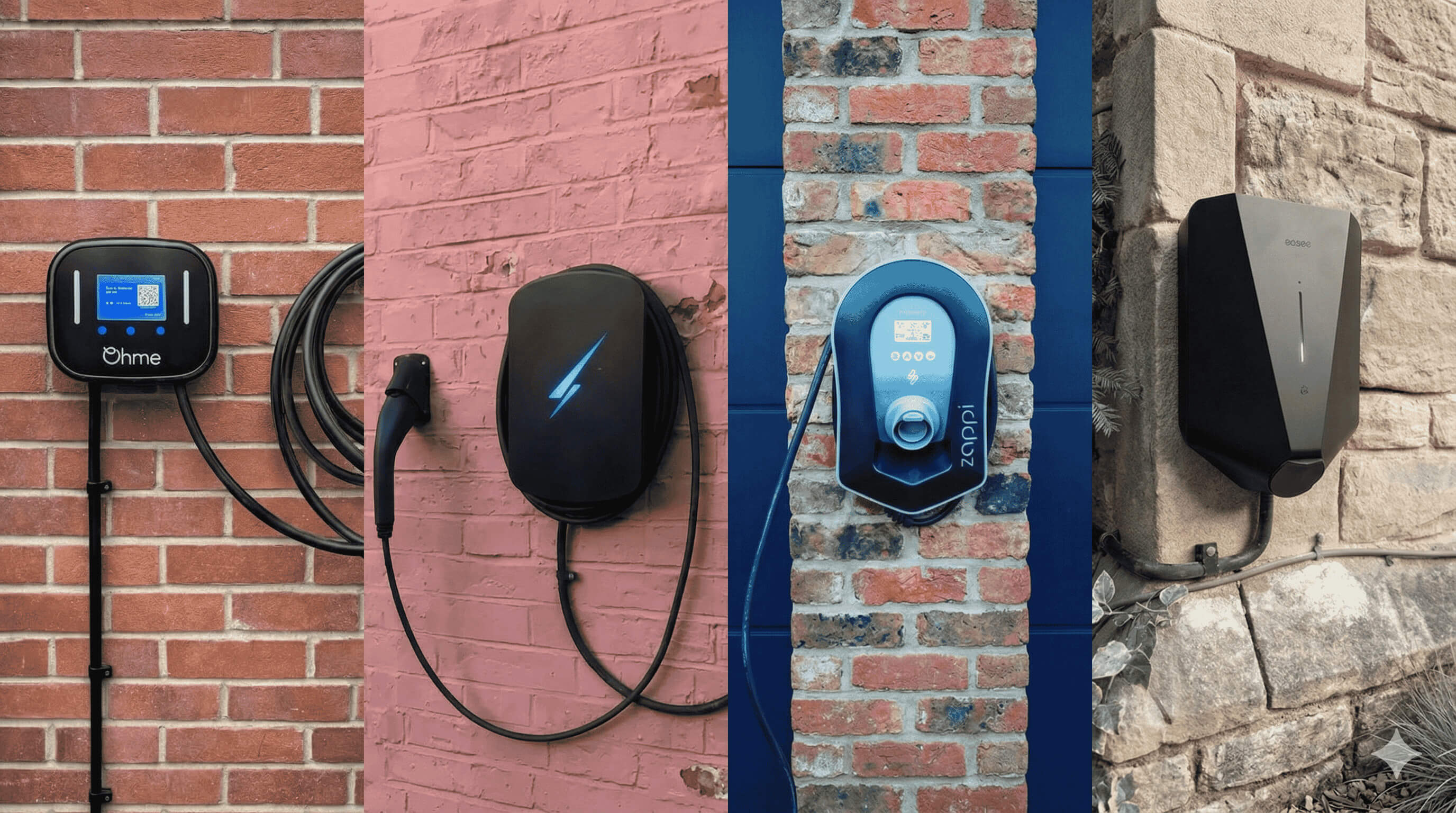
The four most popular home chargers we install in Hertfordshire are the Ohme Home Pro, Hypervolt Home 3.0, Easee One, and Zappi by myenergi. Here is how they compare on price.
| Charger | Charger unit price | Typical all-in installed cost | Best for |
| Ohme Home Pro | £700–£900 | £850–£1,300 | Tariff optimisation, Octopus users |
| Hypervolt Home 3.0 | £650–£850 | £900–£1,350 | Solar owners, British-made option |
| Easee One | £650–£850 | £900–£1,400 | Multiple EVs, load balancing |
| Zappi (myenergi) | £800–£1,100 | £1,100–£1,600 | Solar panel owners, eco charging |
These are typical all-in installed costs including the charger unit, labour, materials, and certification. They assume a standard installation without additional work such as a consumer unit upgrade or groundwork. If you want to understand the differences between these chargers beyond price, see our EV charger comparison guide.
What Affects the Cost of EV Charger Installation?

No two installations are identical, and the price difference between a simple job and a complex one can be several hundred pounds. Here are the main factors we assess when quoting.
Distance from consumer unit to parking space
This is the single biggest variable in most installations. A charger mounted on a wall directly above a garage where the consumer unit also lives is a very different job to a charger positioned at the end of a 20-metre driveway. Every extra metre of cable adds to material costs and installation time. A short cable run (under 5 metres) adds very little to the overall cost; a run of 15 metres or more will add £100–£250 depending on the route and complexity.
Consumer unit condition and capacity
Your EV charger needs a dedicated 32A circuit from your consumer unit. If your consumer unit is modern, has a spare circuit way, and has adequate RCD protection, this is straightforward to add. If your consumer unit is old, lacks spare ways, or does not meet current regulations, it may need upgrading before we can install the EV charger circuit safely. A consumer unit upgrade typically adds £300–£800 to the total cost, but it also improves the safety of your whole home’s electrics. See our separate guide on whether you need a consumer unit upgrade for an EV charger.
Earthing arrangements
Most UK homes have a PME (Protective Multiple Earthing) supply, also known as TN-C-S. This is the standard arrangement where the earth and neutral are combined in the incoming supply cable. For EV charger installations, current regulations require careful assessment of the earthing at the vehicle connection point. In many cases, an additional earth electrode needs to be installed — a copper rod driven into the ground near the charger. This adds around £150–£300 to the cost and is a safety requirement, not an upsell.
Properties with a TT earthing arrangement (where the home already has its own earth electrode) are usually simpler and less expensive to work with in this regard.
Charger mounting position: wall-mounted vs post-mounted
A wall-mounted charger on a solid external wall is the most straightforward installation. If your parking space is away from any wall — on an open driveway, for example — a post-mounted charger may be needed. This involves installing a steel post anchored in the ground, with the cable run underground to reach it. Groundwork and a post-mounted installation typically adds £200–£400 depending on the driveway surface and depth of run.
Property type and access
Older properties — Victorian terraces, 1930s semis, post-war housing — often present more complexity than modern new builds. Solid walls, limited loft access, and older consumer units all affect how straightforward the cable route is. We have extensive experience with Hertfordshire’s mix of housing stock, and we plan our cable routes carefully to minimise both cost and disruption.
Real-World Cost Examples for Hertfordshire Installations
Numbers make more sense with context. Here are five typical installation scenarios and what they generally cost for Hertfordshire homeowners.
| Scenario | Charger | Additional work | Typical total cost |
| Standard install, short cable run, modern consumer unit | Ohme Home Pro | None | ~£1,100 |
| Standard install, short cable run, modern consumer unit | Zappi | None | ~£1,350 |
| Longer cable run (10m+), earth rod required | Easee One | Earth rod | ~£1,450–£1,600 |
| Standard install, consumer unit upgrade needed | Zappi | Consumer unit upgrade | ~£1,600–£1,900 |
| Post-mounted charger on driveway, groundwork required | Hypervolt 3.0 | Groundwork, post | ~£1,500–£1,800 |
These are illustrative figures based on real installations. Your actual quote will reflect your specific property, charger choice, and any additional work required. We always provide an itemised, fixed-price quote before any work begins.
Can I Reduce the Cost With a Grant?
Possibly, yes. The government’s EV chargepoint grant scheme provides funding toward the supply and installation of a home charger for eligible homeowners and renters. The current scheme requires a smart charger from an approved installer — all four chargers we recommend qualify, and we are an approved installer.
Grant amounts and eligibility criteria can change, so we always confirm the current position when you get in touch for a quote. We handle the application on your behalf as part of the installation process — it is not something you need to manage yourself.
We will be publishing a dedicated guide to EV charger grants in 2026 with full eligibility details. In the meantime, get in touch and we will advise on what is available at the time of your installation.
Hidden Costs to Watch Out For
Not all installers are as transparent as we try to be. Here are some things that can cause the final bill to differ from the original quote, and how to protect yourself.
- Vague estimates rather than fixed quotes. “From £X” is not a fixed price. Ask for an itemised quote based on a site survey or detailed photos.
- Earthing charges added on the day. The need for an earth rod can be assessed before installation. It should be included in your quote, not raised as a surprise.
- Consumer unit work not disclosed upfront. If your consumer unit needs upgrading, this should be identified at the survey stage and included in the quote.
- Permit and certification not included. Part P compliance and certification should always be included. If an installer offers a very low price without mentioning certification, ask why.
- Cheap chargers that do not qualify for grants. Some very low-cost units are not on the approved products list for the grant scheme. Always check before committing.
We provide fixed-price, itemised quotes based on a proper assessment of your property — either through a site visit or a detailed photo review. What we quote is what you pay.
What Is Included in Our EV Charger Installation?
When you book with Hitches & Glitches, your installation includes:
- A dedicated 32A circuit from your consumer unit
- Circuit protection appropriate to your installation
- Cable installed neatly and securely, with trunking or conduit where exposed
- Earth rod installation where required for PME supplies
- Charger mounted, connected, and fully commissioned
- App setup and demonstration so you can use all smart features from day one
- Grant application handled on your behalf (where eligible)
- Full electrical installation certificate
- Part P Building Regulations compliance notification
- Our workmanship guarantee
As a family-run team, you will deal with us directly throughout. No call centres, no subcontractors, no surprises.
Is a Home EV Charger Worth the Investment?
For most EV owners, a home charger pays for itself relatively quickly when you factor in the cost savings compared to public charging.
Public rapid chargers typically cost between 55p and 85p per kWh. Charging at home on a standard tariff costs around 22–24p per kWh. On a smart overnight tariff such as Octopus Go or Intelligent Octopus, you can charge for as little as 7–10p per kWh.
Here is a rough comparison for a driver covering 10,000 miles per year in an EV averaging 3.5 miles per kWh (approximately 2,860 kWh per year):
- Public rapid charging at 65p/kWh: approximately £1,860 per year
- Home charging at standard rate (23p/kWh): approximately £660 per year
- Home charging on smart tariff (8p/kWh): approximately £230 per year
A home charger costing £1,200 all in pays for itself within one year if you are currently using public rapid chargers for most of your charging. Even compared to home charging on a standard tariff, moving to a smart overnight tariff through a charger like the Ohme Home Pro can save £400+ per year.
These are illustrative figures — your savings will depend on your mileage, your car’s efficiency, and your energy tariff. But the direction of travel is clear: for regular EV drivers, a home charger is a sound investment.
Frequently Asked Questions
How much does EV charger installation cost in Hertfordshire?
Most home EV charger installations in Hertfordshire cost between £800 and £1,500 all in, including the charger unit, installation labour, materials, and certification. Jobs involving additional work — such as a consumer unit upgrade, long cable runs, or groundwork for a post-mounted charger — can cost more. We provide fixed-price quotes based on your specific property.
Does the type of charger affect the installation cost?
Yes, though the difference between charger models is usually £150–£300 on the overall installed cost. The Ohme Home Pro and Hypervolt Home 3.0 sit at the more affordable end; the Zappi and Easee One are priced slightly higher for the unit. All qualify for the government EV chargepoint grant. The bigger cost variables are property-specific factors such as cable run length and consumer unit condition.
Do I need to upgrade my consumer unit before getting an EV charger?
Not always. If your consumer unit is modern and has a spare circuit way with adequate RCD protection, no upgrade is needed. If it is old, full, or does not meet current regulations, an upgrade may be required. We assess this as part of our site survey or photo review. If an upgrade is needed, we will include it in your quote so there are no surprises. Our guide on consumer unit upgrades for EV chargers explains this in more detail.
Can I get a grant to reduce the cost?
Possibly. The government’s EV chargepoint grant scheme provides funding toward the installation cost for eligible homeowners and renters. All four chargers we recommend qualify as smart chargers, and we are an approved installer. We handle the grant application on your behalf. Eligibility criteria and grant amounts can change, so we will confirm the current position when you enquire.
How do I get an accurate quote?
The most accurate way is to share a set of photos of your electrical setup — specifically your consumer unit, main cut-out fuse, incoming supply cable, and electric meter — along with the location where you would like the charger installed. We can usually provide a fixed-price quote from photos alone. If anything needs clarifying, we will arrange a free site visit. Fill in our EV charger quote form or call us on 07736 736233 to get started.
I’m not sure which charger to go for?
Our comparison guide covers the Zappi, Easee, Ohme, and Hypervolt side by side — or browse the individual brand guides for each one.
Ready to Get Your Free EV Charger Installation Quote?
Call us on 07736 736233 or fill in our EV charger quote form for a free, no-obligation assessment. We cover Watford, St Albans, Hemel Hempstead, Bushey, Rickmansworth, and throughout Hertfordshire. We will advise honestly on the right charger for your home, handle the grant application if you are eligible, and take care of everything from installation through to final certification.